
Per Oxford Bibliographies, evidentiality is a grammatical category with the source of information as its primary meaning—whether the speaker saw the event happen, did not see it but heard it, made an inference based on general knowledge or visual traces, or was told about it. It is a relatively new topic in linguistics, and there is a lively discussion about how much evidentiality is a matter of grammar or semantics.
In the article Epistemological positioning and evidentiality in English news discourse: A text-driven approach, Monika Bednarek offers a distinction between evidentiality and epistemiological positioning, which she finds suitable for studying news. In narrow terms, epistemological positioning addresses the question of the source of information, the basis and certainty of their knowledge. She also connects it with sourcing and attribution.
The adverbs “apparently” and “supposedly” were used in the earliest editions of The London Gazette to indicate that the information being reported was not specific but rather something that had been heard or read. It is interesting to note that the use of the adverbs “apparently” and “supposedly” in the London Gazette seems to have increased over time (seems here means that on a small sample that has been researched, results were consistent, but the sample is rather small). In the early editions of the Gazette, these adverbs were rarely used. However, they were frequently used by the end of the 17th century. This suggests that journalists were becoming more aware of the importance of conveying the uncertainty of information and that they were using these adverbs to do so.
Apparently
The earliest known use of the adverb apparently is in the Middle English period (1150—1500). OED’s earliest evidence for apparently is from before 1400, in the Chester Plays. It comes from French.
“Apparently the French King is much better in health than he was reported to be.” (London Gazette, 1666)
“There is apparently a great want of provisions in the town, and the people begin to be very uneaʃy.” (London Gazette, 1667)
Supposedly
The earliest known use of the adverb supposedly is in the late 1500s. It comes from French.
OED’s earliest evidence for supposedly is from 1597, in St. Peters Ten Teares.
“It is supposedly the intention of the French to invade England.” (London Gazette, 1670)
“The Spanish fleet is supposedly on its way to England.” (London Gazette, 1673)
Clearly
The earliest known use of the adverb clearly is in the Middle English period (1150—1500).
OED’s earliest evidence for clearly is from around 1300, in St. Brandan. It comes from Old English.
“…where upon diligent examination and inquiʃition, it was clearly and fully evidenced by the teʃtimony of Twelve credible witneʃses upoYi oath..” (London Gazette, 1670)
“Aud that the Beams pf Your Royal Favour might Clearly thine upon us, Your Majeʃty is pleaʃed therein alʃo to give us ʃuch aʃʃuirances ot’Your tature Conduct, as ought to consume in us the moʃt fined Beʃet’ – of a constant Enjo. ment ot” thoʃe precious Bleʃʃings, which haave been ʃo long…“ (London Gazette,1681)
Also, many adverbs and verbs would characterize as “hearsay,” “mindsay” or general knowledge.
Over the span of 200 years of The London Gazette, ‘tis believed and ‘twas believed was often the only designation offered. On the other hand, say, said, and afforesaid has been almost exclusively used in the sense of “previously mentioned” and not as a verb in a sentence attributing the information to a named source. Having in mind that in the early days, the main source was diplomatic correspondence, it is not surprising that the most often attribution, when one is given, is vague, such as letters say.
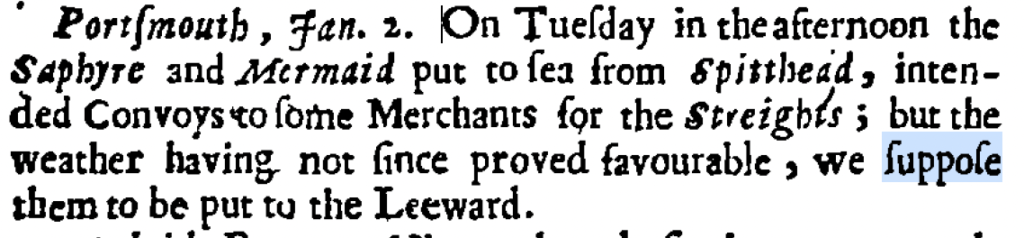
In edition from Jan 2-6, 1967 of The London Gazette, “suppose” has been used to mark the insufficient reliability of the information or what the writer has inferred from it:
- Portsmouth , Jan. 2. On Tuesday in the afternoon the Saphyre sad Mermaid put to sea from Spittheid, intended Convoys to some Merchants for the Streigbis ; but the weather having, not since proved favourable, we suppose them to be put to the Leeward.-
“It’s reported here..” – the verb reported appears early but not in the modern sense. The noun is used interchangeably with letters. According to the Oxford English Dictionary (OED), the verb report and the noun report both come from the Latin word reportare, re- ‘back’ + portare ‘carry,’ which means “to carry back” or “to bring back.”
The verb report first appeared in English in late Middle English (14th century), and it originally meant “to bring back news or information.” Over time, the meaning of the verb expanded to include “to give an account of something,” “to make a statement,” and “to make a formal complaint.”
The noun report first appeared in English in the early 15th century, and it originally meant “a message or account brought back.” Over time, the meaning of the noun expanded to include “a formal statement of facts,” “a piece of news,” and “a rumor.”