
In England, news began to be circulated in print early in the 16th century in publications called ‘Relations.’ The earliest surviving example of these forerunners of the English newspaper is an account of the Battle of Flodden in 1513, published as a small pamphlet under the title Hereafter Ensue the Trewe Encountre or Batayle lately Don betwene Englande and Scotlande. Pamfets like these appeared occasionally and in increasing numbers during the late 1500s. The news was not printed more regularly and within periodical publications in England until the early 17th century. (Moira Goff, Early History of the English Newspaper)
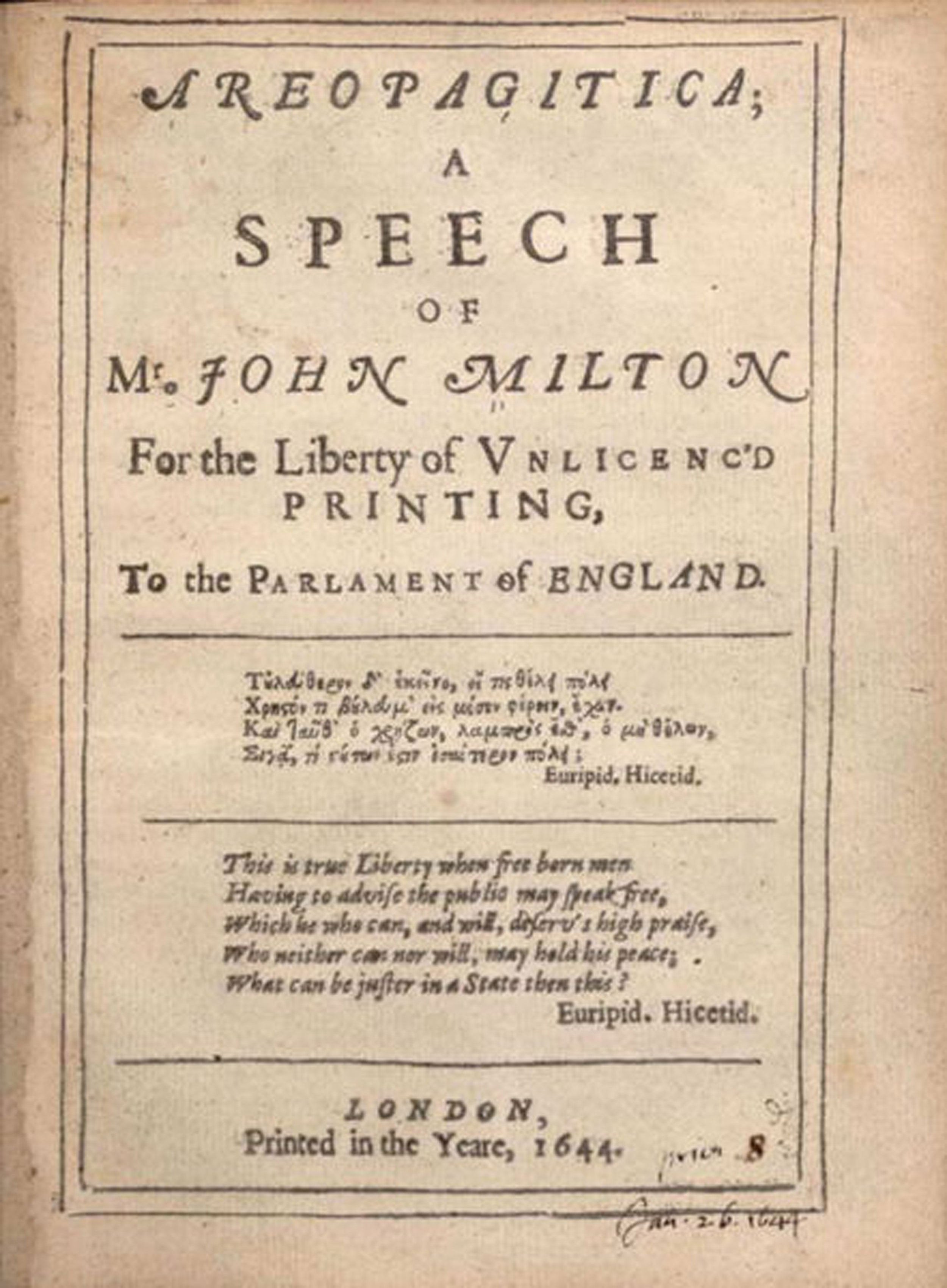
Because many of these early publications were regulated by the government, they did not report on local news or events. However, when civil war broke out in England in 1641, as Oliver Cromwell and Parliament threatened and eventually overthrew King Charles I, citizens turned to local papers for coverage of these major events. In November 1641, a weekly paper titled The Heads of Severall Proceedings in This Present Parliament began focusing on domestic news (Goff, 2007). The paper fueled a discussion about the freedom of the press that was later articulated in 1644 by John Milton in his famous treatise Areopagitica. (From History of Newspapers, University of Michigan)
At the beginning of the 17th century, the right to print was strictly controlled in England. This was probably the reason why the first newspaper in the English language was printed in Rome by Joris Veseler around 1620. This followed the style established by Veseler’s earlier Dutch paper Courante uyt Italien, Duytslandt, &c. However, when the English started printing their own papers in London, they reverted to the pamphlet format used by contemporary books. The publication of these newsbooks was suspended between 1632 and 1638 by order of the Star Chamber. After they resumed publication, these newsbooks’ era lasted until the Oxford Gazette’s publication in 1665. (Moira Goff, Early History of the English Newspaper)
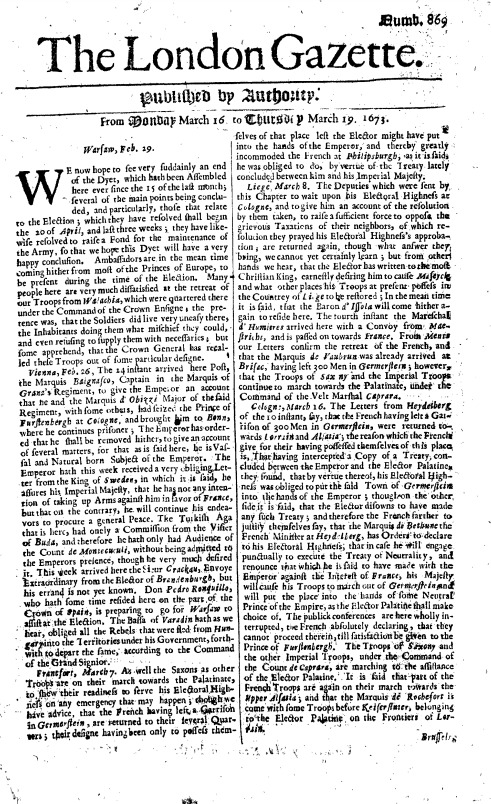
The Oxford Gazette was established as a government newsbook in 1665, and succeeded by the London Gazette in 1666. Its format as a single sheet, printed on both sides, earned it a description as the first English newspaper. It is the oldest continuously published newspaper in the world.
The London Gazette is the oldest continuously published newspaper in the world. It was first published on November 7, 1665, as The Oxford Gazette, while the court of King Charles II was in exile in Oxford during the Great Plague of London. It was renamed The London Gazette when the court returned to London in 1666.
The London Gazette is one of the official journals of record or government gazettes of the Government of the United Kingdom. It is published by TSO (The Stationery Office) on behalf of His Majesty’s Stationery Office. The Gazette contains a wide variety of legal and official notices, which is why it is a valuable source of information for anyone interested in the British government, business, and society. It is also a fascinating historical document, providing a glimpse into the life and times of Britain over the past 350 years.In 1702 The Daily Courant started as the first daily newspaper in England. In 1711 The Spectator was published, a literary and political journal that helped to shape the English public sphere. And eventually, in 1785, The Times started being published, one of the most influential newspapers in the world.